

The short answer
Psalm 23 is a song of trust, and tradition holds that David wrote it. It pictures God as a shepherd who feeds and leads you, then as a host who sets a table for you. The dark valley and the enemies are still there in the psalm, and God is with you in both.
Psalm 23 in full
This is one of the most-read chapters in the Bible. Here it is in the World English Bible, numbered by verse. It takes less than a minute to read aloud, so try that first.
- “The LORD is my shepherd; I shall lack nothing.”
- “He makes me lie down in green pastures. He leads me beside still waters.”
- “He restores my soul. He guides me in the paths of righteousness for his name’s sake.”
- “Even though I walk through the valley of the shadow of death, I will fear no evil, for you are with me. Your rod and your staff, they comfort me.”
- “You prepare a table before me in the presence of my enemies. You anoint my head with oil. My cup runs over.”
- “Surely goodness and loving kindness shall follow me all the days of my life, and I will dwell in the LORD’s house forever.”
Who wrote Psalm 23?
The psalm opens with the heading “A Psalm by David.” Tradition holds that David wrote it. The Hebrew heading could also mean a psalm for David or from his collection, and nobody can tie it to one moment in his life.
The tradition fits the man. David was the youngest son, out “keeping the sheep” when the prophet Samuel came looking for Israel’s next king (1 Samuel 16:11). He later told King Saul that when a lion or a bear took a lamb, “I went out after him” (1 Samuel 17:35). He knew what a shepherd does for a flock.
Kings in the ancient Near East liked to call themselves shepherds of their people, and Psalm 78:71 says God made David “the shepherd of Jacob”. So if David wrote this psalm, Israel’s shepherd is calling himself a sheep.
The LORD is my shepherd (verses 1–3)
“The LORD is my shepherd; I shall lack nothing.” LORD in capitals stands for God’s personal name in Hebrew, and the next words make it personal: “my shepherd”. A shepherd in ancient Israel lived with his flock and had to find it food and water in dry hill country. So this is what a well-kept sheep could say: I have what I need, because someone is looking after me. It doesn’t mean you’ll get everything you wish for. Older English Bibles say want in this line, in the old sense of lack.
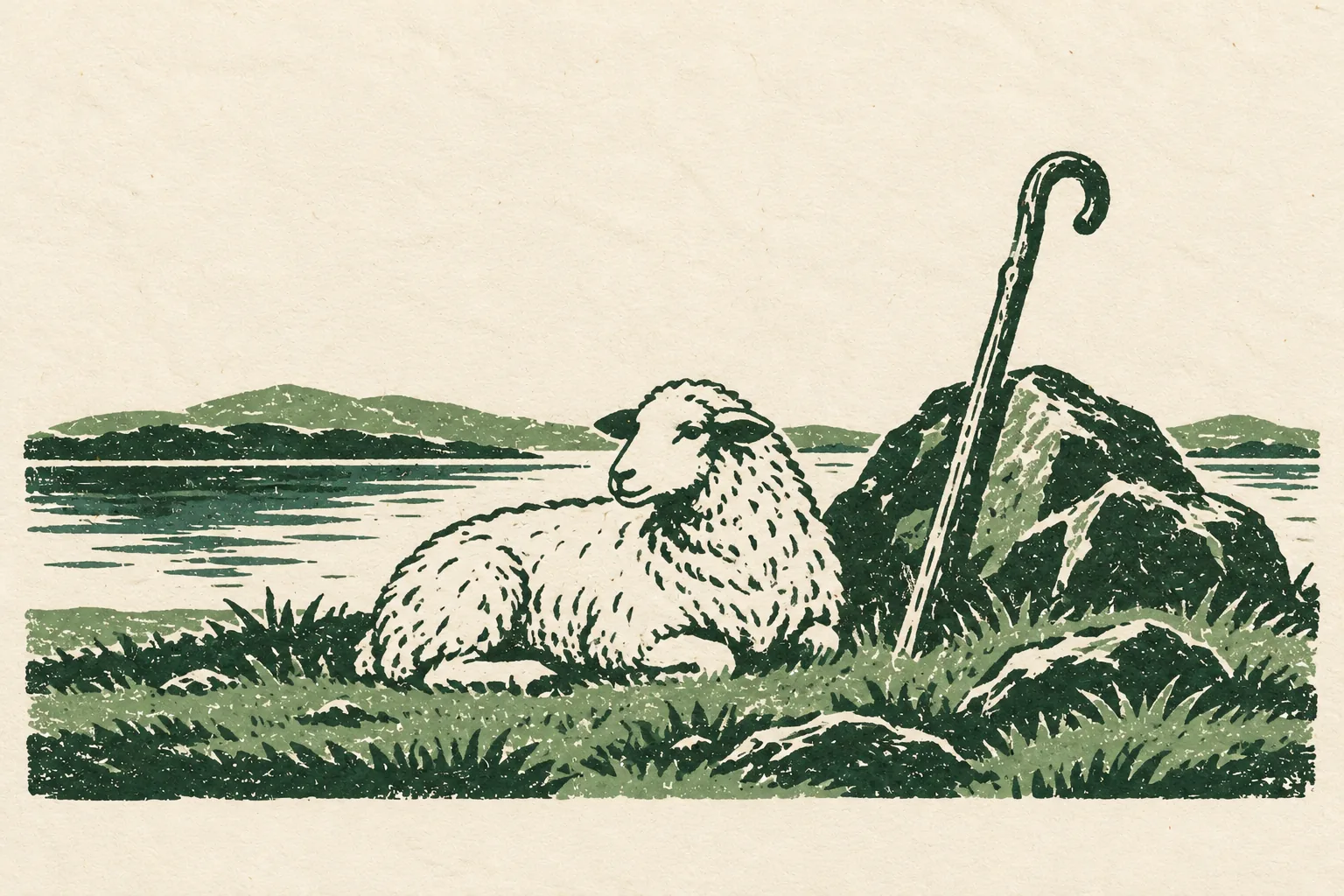
“He makes me lie down in green pastures. He leads me beside still waters.” Grass and calm water are hard to find in that country, so the shepherd has to know where they are and take the flock there. The Hebrew for still waters is closer to waters of rest. The sheep are fed, safe and lying down, and the psalm credits all of it to the shepherd.
“He restores my soul.” In the Psalms, soul means your whole self, your life and breath, and the verb means to bring back. When you’re spent, God brings you back.
“He guides me in the paths of righteousness for his name’s sake.” The paths of righteousness are the right paths, the ones that lead somewhere good. The phrase “for his name’s sake” means God does this because of who he is. A good shepherd has a name to keep.
The valley of the shadow of death (verse 4)
“Even though I walk through the valley of the shadow of death, I will fear no evil, for you are with me.” The Hebrew behind shadow of death can also mean deep darkness, and some translations say the darkest valley. So this line fits a deathbed, and it also fits any dark stretch of life: a diagnosis, a depression, a fear that won’t lift.
Notice what happens to the words. Until now the psalm has talked about God: he leads, he restores. In the dark it turns and talks to him: “for you are with me”. The path still runs through the valley, and the shepherd walks it with you.
“Your rod and your staff, they comfort me.” A shepherd carried two tools. The rod was probably a short club for driving off wild animals, and the staff was a long stick for guiding the sheep. One protects and the other leads. Either one tells a frightened sheep that the shepherd is close.
The table, the oil and the cup (verse 5)
Here the picture changes. Most readers see the shepherd become a host and the sheep become a guest.
“You prepare a table before me in the presence of my enemies.” In the ancient Near East, a host was bound to protect anyone who ate at his table. So the enemies are still in view, and you sit down and eat anyway, because the host has taken you under his care.
“You anoint my head with oil.” A good host poured scented oil on a guest’s head as a welcome and an honor. “My cup runs over” means he keeps pouring until you have more than enough.
Goodness and the LORD’s house (verse 6)
“Surely goodness and loving kindness shall follow me all the days of my life”. The Hebrew verb for follow usually means to pursue. It’s the word for an enemy chasing you. In this psalm, what’s chasing you is God’s goodness and his loving kindness, or hesed, the loyal love that keeps its promises.
The last line brings you indoors: “and I will dwell in the LORD’s house forever.” A guest goes home after the meal, and this one gets to stay. The LORD’s house was the place where Israel met with God. Christians have long heard this line as a hope that reaches past death.
What does Psalm 23 say about God?
Put together, the psalm says God is close, he provides, he stays with you in the dark and he wants you at his table. The shepherd picture carries that idea through the whole Bible. Isaiah says of God, “He will gather the lambs in his arm, and carry them in his bosom.” (Isaiah 40:11). In Ezekiel, after Israel’s leaders have failed the people, God says, “I myself will be the shepherd of my sheep” (Ezekiel 34:15).
The New Testament picks up the same thread. In John 10, Jesus takes the title of shepherd for himself. Hebrews calls him “the great shepherd of the sheep” (Hebrews 13:20), and 1 Peter tells its readers that they have “returned to the Shepherd and Overseer of your souls” (1 Peter 2:25). So Christians read Psalm 23 as a description of the care they find in Jesus.
How to pray Psalm 23
- Read it slowly, aloud if you can.
- Stop at the line that fits today. You may need rest, or be in the valley, or be facing someone who opposes you.
- Change he to you, as the psalm itself does in verse 4, and say that line to God.
- Carry that one line with you through the day.
The psalm is short enough to learn by heart, and our guide to saving and memorizing Bible verses shows how. It’s also one of the psalms in our bedtime routine. If fear is what brought you here, our list of Bible verses for anxiety has more to read.
Common questions
What is the main message of Psalm 23?
That God cares for you personally through all of life. He provides for you, leads you, stays with you in the dark and welcomes you home. If you want the psalm in five words, take them from verse 4: “for you are with me”.
Is it the valley of death or the valley of the shadow of death?
The psalm says “the valley of the shadow of death”. People often shorten it to the valley of death, a phrase from Tennyson’s poem about the Light Brigade. The longer phrase is the kinder one: it can mean deep darkness, and the writer walks through it and keeps going.
Why is Psalm 23 read at funerals?
Because of the valley in verse 4 and the LORD’s house in verse 6. It belongs at a funeral, but most of the psalm is about living: food, water, rest, guidance and “all the days of my life”. You don’t have to save it for the end.
What does “My cup runs over” mean?
It means you have more than you need. The picture comes from a meal where the host keeps filling your cup. The line comes right after the enemies, so this is generosity in a hard place.