

The short answer
Advent is the season of the four Sundays before Christmas, when churches get ready to celebrate Jesus’ birth and look ahead to his return. The word means coming. In 2026, Advent begins on Sunday, November 29, and runs to Christmas Eve. The Bible never names the season, but nearly all of its readings come from Scripture, many of them from Isaiah.
What does Advent mean?
Advent comes from the Latin adventus, which means coming or arrival. The season looks two ways at once. It remembers how long God’s people waited for the Messiah before Jesus was born in Bethlehem, and it looks ahead to the day Christians believe he will come again.
That is why Advent doesn’t start at the manger. The first weeks are about waiting and watching, and the readings reach Bethlehem only near the end. In Western churches, the first Sunday of Advent is also the first day of the church year.
Isaiah gives the season its mood: “The people who walked in darkness have seen a great light.” (Isaiah 9:2).
When does Advent start?
Advent begins on the fourth Sunday before Christmas, which always falls between November 27 and December 3, and it ends on Christmas Eve. So it lasts anywhere from 22 to 28 days.
| Year | First | Second | Third | Fourth |
|---|---|---|---|---|
| 2026 | Nov 29 | Dec 6 | Dec 13 | Dec 20 |
| 2027 | Nov 28 | Dec 5 | Dec 12 | Dec 19 |
| 2028 | Dec 3 | Dec 10 | Dec 17 | Dec 24 |
Orthodox churches keep a longer season instead, the Nativity Fast. It lasts 40 days, from November 15, or from November 28 in churches that follow the older Julian calendar.
What do the Advent candles mean?
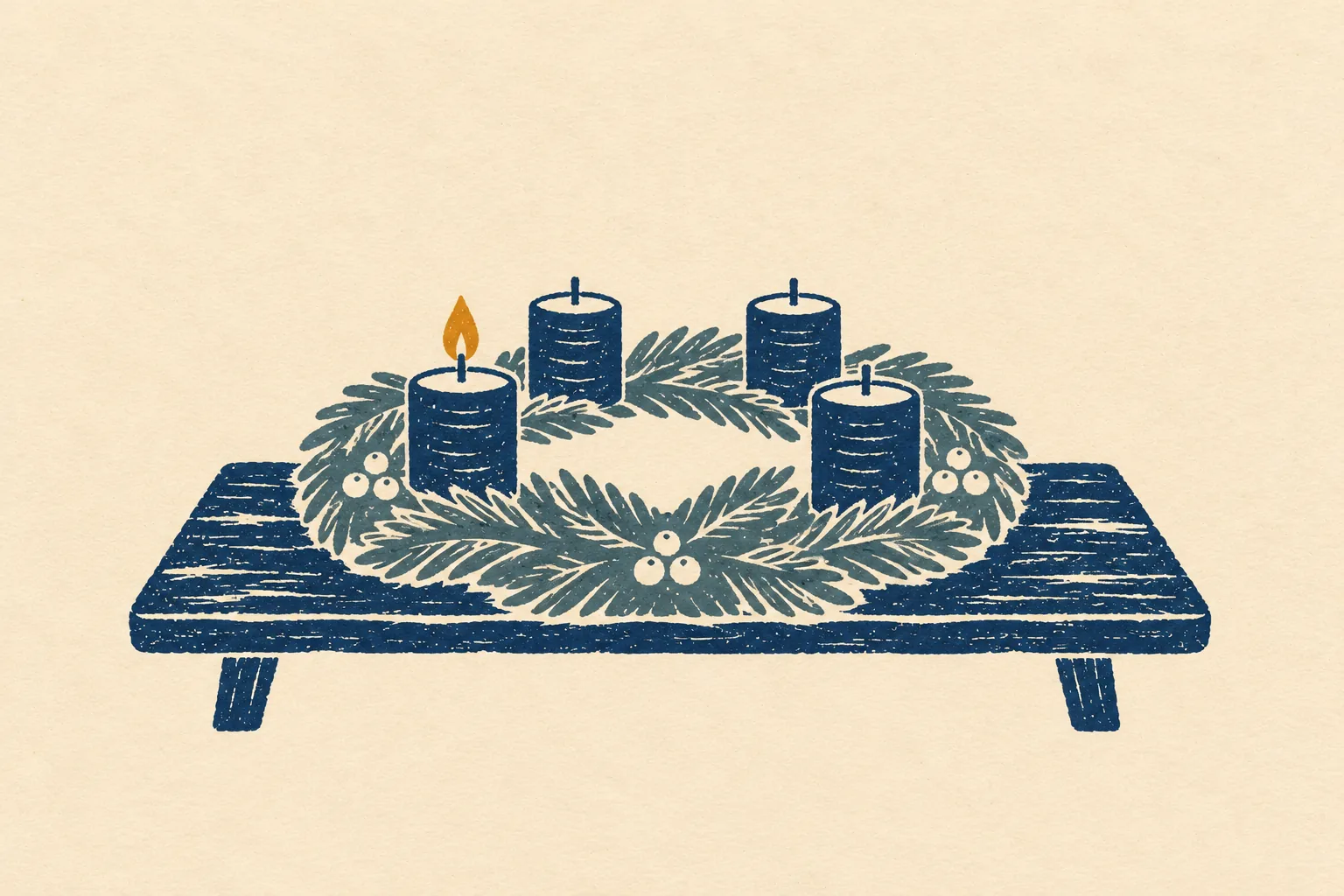
An Advent wreath is a ring of evergreen branches with four candles, one lit on each Sunday of Advent. Many families add a white candle in the middle, the Christ candle, and light it on Christmas Eve or Christmas Day. The custom is usually traced to Johann Hinrich Wichern, a Lutheran pastor in Hamburg, who in 1839 made a wooden wreath with a candle for every day of Advent for the children in his care. The four-candle wreath came later.
Most churches use three purple candles and one pink, which is lit on the third Sunday. That Sunday is called Gaudete, Latin for rejoice, after the first words of Philippians 4:4: “Rejoice in the Lord always!” Some churches use blue instead of purple. The themes below are common in Protestant churches, but they vary.
| Sunday | Candle | Often stands for | A verse to read |
|---|---|---|---|
| First | Purple | Hope | Psalm 130:5 |
| Second | Purple | Peace | Isaiah 9:6 |
| Third | Pink | Joy | Philippians 4:4 |
| Fourth | Purple | Love | 1 John 4:9 |
| Christmas | White | Christ | Luke 2:1–20 |
Some churches name the four candles for the prophets, Bethlehem, the shepherds and the angels instead. Either set works at home.
Is Advent in the Bible?
No. Neither the word nor the season appears in Scripture. The first clear records come from France in the late 400s, where Christians fasted three days a week from St. Martin’s Day, November 11, to Christmas. By about 600, churches in Rome kept four Sundays before Christmas, much as most churches do today.
The waiting it marks runs all through the Bible, though. The prophets looked for a king from David’s family: “A shoot will come out of the stock of Jesse, and a branch out of his roots will bear fruit.” (Isaiah 11:1). Luke’s Gospel tells of Simeon and Anna, two old people who waited in the temple for years (Luke 2:25–38). And the New Testament asks Christians to wait for Jesus’ return the way a farmer waits for rain: “You also be patient. Establish your hearts, for the coming of the Lord is at hand.” (James 5:8).
Bible verses for Advent
Every verse in this guide is quoted from the World English Bible, with a line about where it comes from.
- Isaiah 40:3. “Prepare the way of the LORD in the wilderness! Make a level highway in the desert for our God.” Written to exiles in Babylon, promising a road home. All four Gospels use it to introduce John the Baptist.
- Micah 5:2. “But you, Bethlehem Ephrathah, being small among the clans of Judah, out of you one will come out to me who is to be ruler in Israel”. Micah named the town about seven centuries before Jesus was born there.
- Isaiah 7:14. “Therefore the Lord himself will give you a sign. Behold, the virgin will conceive, and bear a son, and shall call his name Immanuel.” Immanuel means God with us. Matthew connects this sign to Jesus’ birth (Matthew 1:22–23).
- Malachi 3:1. “Behold, I send my messenger, and he will prepare the way before me!” Malachi is the last book of the Old Testament in most Bibles, so it closes with God’s people waiting. Mark’s Gospel opens by quoting this verse (Mark 1:2).
- Psalm 130:5. “I wait for the LORD. My soul waits. I hope in his word.” A song for pilgrims walking up to Jerusalem, and a short prayer for the first week.
- Romans 13:12. “The night is far gone, and the day is near.” Paul wrote it about living ready for Christ’s return, and many churches read it on the first Sunday of Advent.
- Isaiah 60:1. “Arise, shine; for your light has come, and the LORD’s glory has risen on you!” A promise to a ruined Jerusalem, read at Epiphany, twelve days after Christmas.
An Advent Bible reading plan
This plan follows the four candles, with four short passages a week, and ends with the Christmas story itself. Read one a day, or all four on Sunday. Most take less than five minutes.
| Week | Theme | Readings |
|---|---|---|
| From Nov 29 | Hope | Isaiah 40:1–11, Isaiah 9:1–7, Psalm 130, Romans 15:4–13 |
| From Dec 6 | Peace | Isaiah 11:1–10, Isaiah 2:1–5, Micah 5:2–5, Psalm 85 |
| From Dec 13 | Joy | Isaiah 35, Zephaniah 3:14–20, Isaiah 61:1–4, Philippians 4:4–7 |
| From Dec 20 | Love | 2 Samuel 7:1–16, Isaiah 7:10–14, Luke 1:26–56, 1 John 4:7–16 |
| Dec 24 and 25 | Christ is born | Luke 2:1–20, Matthew 1:18–2:12, Titus 2:11–14 |
If you’d rather read one book, Luke’s Gospel has 24 chapters: one a day from December 1 brings you to the end on Christmas Eve.
How to keep Advent at home
Advent was once a season of fasting, like Lent, and it still asks you to slow down while everything around you speeds up. A few small habits are enough.
- Pick a time you can keep, such as dinner or bedtime, and give it five or ten minutes.
- Each Sunday, light the week’s candle and read the verse beside it in the table above.
- On the other days, read one of that week’s passages. Let a child read the shortest one aloud.
- Leave a little room. Some families save the carols or the tree for later in the month, so the waiting means something.
- Give something away each week: to a neighbor, a food bank or someone who will spend Christmas alone.
If you miss a day, start again where you are and don’t try to catch up. For a habit that lasts past December, see our guide to building a daily Bible reading habit.
Common questions
When does Advent start in 2026?
On Sunday, November 29, 2026. It ends on Christmas Eve, Thursday, December 24. In 2027, Advent starts on Sunday, November 28.
Is Advent only for Catholics?
No. Catholic, Anglican, Lutheran, Methodist, Presbyterian and many other churches keep Advent, and plenty of families who don’t follow the church year still use a wreath or a reading plan. Orthodox churches keep the Nativity Fast instead.
Why is the third Advent candle pink?
The third Sunday, Gaudete Sunday, marks a turn toward joy as Christmas comes near, so the color lightens from purple to rose. Its name is the first word of Philippians 4:4 in Latin.
Do you fast during Advent?
Most Western churches no longer ask for a fast in Advent, though some Christians keep one by choice, often by giving up a treat until Christmas. Orthodox Christians keep the Nativity Fast, which usually leaves out meat and dairy.