

The short answer
Psalm 91 is a song of trust that calls God a shelter for anyone who makes him their home. It promises his care and his rescue, and it ends with God saying, “I will be with him in trouble.” It doesn’t promise that believers will never be hurt, and the Bible itself shows faithful people suffering.
Psalm 91 in full
Here is the whole psalm in the World English Bible, numbered by verse.
- “He who dwells in the secret place of the Most High will rest in the shadow of the Almighty.”
- “I will say of the LORD, ‘He is my refuge and my fortress; my God, in whom I trust.’”
- “For he will deliver you from the snare of the fowler, and from the deadly pestilence.”
- “He will cover you with his feathers. Under his wings you will take refuge. His faithfulness is your shield and rampart.”
- “You shall not be afraid of the terror by night, nor of the arrow that flies by day,”
- “nor of the pestilence that walks in darkness, nor of the destruction that wastes at noonday.”
- “A thousand may fall at your side, and ten thousand at your right hand; but it will not come near you.”
- “You will only look with your eyes, and see the recompense of the wicked.”
- “Because you have made the LORD your refuge, and the Most High your dwelling place,”
- “no evil shall happen to you, neither shall any plague come near your dwelling.”
- “For he will put his angels in charge of you, to guard you in all your ways.”
- “They will bear you up in their hands, so that you won’t dash your foot against a stone.”
- “You will tread on the lion and cobra. You will trample the young lion and the serpent underfoot.”
- “Because he has set his love on me, therefore I will deliver him. I will set him on high, because he has known my name.”
- “He will call on me, and I will answer him. I will be with him in trouble. I will deliver him, and honor him.”
- “I will satisfy him with long life, and show him my salvation.”
Who wrote Psalm 91?
Nobody knows. In Hebrew the psalm has no heading, so it doesn’t name a writer or a date. Jewish tradition links it to Moses because it follows Psalm 90, “A Prayer by Moses”, and the ancient Greek translation credits it to David.
Listen for three voices as you read. In verses 1 and 2, someone states their trust in God. In verses 3 to 13, a voice speaks to you directly. In verses 14 to 16, God himself answers.
The secret place (verses 1–2)
“He who dwells in the secret place of the Most High will rest in the shadow of the Almighty.” The secret place is a hiding place, somewhere an enemy can’t find you. To dwell there is to live there, the way you live in a home. You may have come to this psalm only because you’re scared tonight. That’s still a way in.
Verse 2 turns that into words you can say: “He is my refuge and my fortress; my God, in whom I trust.” A refuge is where you run, and a fortress is where an attacker can’t reach you.
Traps, feathers and arrows (verses 3–8)
The fowler was a bird-catcher, and his snare was a hidden trap. The deadly pestilence is an epidemic. The psalm is naming the dangers people feared most: the ones you can’t see coming and can’t fight.
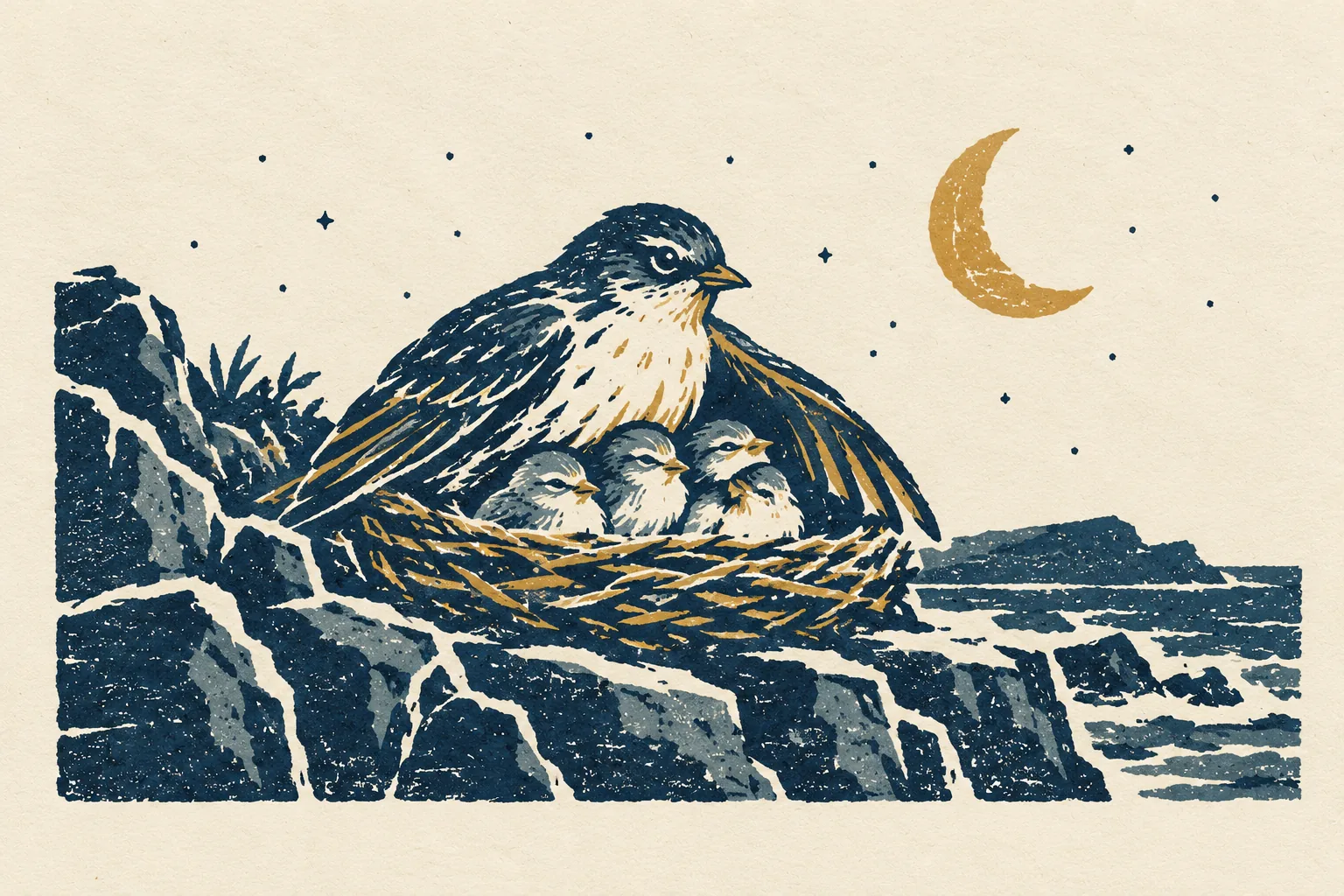
Then comes one of the tenderest pictures in the Psalms: “He will cover you with his feathers. Under his wings you will take refuge.” God is like a mother bird with her chicks tucked under her. The same verse switches to a soldier’s picture: “His faithfulness is your shield and rampart.”
Verses 5 and 6 name the terror by night, the arrow by day, the pestilence in darkness and the destruction at noon. That covers every hour there is. No part of the day falls outside God’s care.
Angels, lions and snakes (verses 9–13)
“For he will put his angels in charge of you, to guard you in all your ways.” Many people’s idea of a guardian angel starts here. The psalm says God’s care reaches further than you can see, and it covers “all your ways”, the ordinary roads along with the dangerous ones.
The lion and the cobra in verse 13 stand for deadly threats: the kind that roars at you and the kind that hides in the path.
God answers (verses 14–16)
At the end, God speaks. In three verses he says “I will” six times. The person he’s talking about is no spiritual expert: someone who loves him, knows his name and calls on him.
The most important line may be the plainest: “He will call on me, and I will answer him. I will be with him in trouble.” That line takes trouble for granted, and God promises to be in it with you.
What Psalm 91 does and doesn’t promise
Read on its own, verse 10 sounds absolute: “no evil shall happen to you”. Verse 7 says that thousands may fall around you and “it will not come near you”. Yet believers get sick, lose children and die in wars and epidemics, the very things this psalm names. An honest reading has to face that.
The Bible faces it. Psalm 44 says, “Yes, for your sake we are killed all day long.” (Psalm 44:22). Hebrews 11 honors people who “stopped the mouths of lions” and, a few lines later, people who were “slain with the sword” (Hebrews 11:33–37). Paul was beaten, stoned and shipwrecked (2 Corinthians 11:25). Jesus died on a cross. None of them lacked faith.
Psalms are poems. They use large pictures to say what God is like, and they aren’t contracts. Verses 7 and 8 picture a battle in which God’s people stand while the wicked fall. That’s a poem’s way of saying God will judge evil and protect his own. It can’t tell you who will survive a given war or plague.
So Psalm 91 promises that God is a real shelter, that he hears you, and that he can and does rescue people. It doesn’t promise that you’ll be kept from every harm, or say how or when rescue will come.
The psalm ends with God saying he will “show him my salvation”, and for Christians that rescue reaches past death. Paul quotes the line from Psalm 44 in Romans 8, and he still writes that “neither death, nor life, nor angels, nor principalities, nor things present, nor things to come, nor powers, nor height, nor depth, nor any other created thing will be able to separate us from God’s love” (Romans 8:38–39). So the worst that can happen to you can’t take you away from God.
If you prayed this psalm over someone and they died, you didn’t pray it wrong. Their death doesn’t mean you lacked faith, or that God stopped listening. Job’s friends decided that suffering must be somebody’s fault, and God told them, “you have not spoken of me the thing that is right” (Job 42:7).
The Gospels add one more warning. During the temptation in the wilderness, the devil quotes this psalm’s promise about angels and dares Jesus to throw himself down from the temple. Jesus refuses. A promise of God’s care can be bent into a dare, so read this psalm as a place to run to, and never as a reason to test God.
How to pray Psalm 91
- Read it slowly and tell God what you’re afraid of.
- Say verse 2 as your own words.
- If you’re praying for someone else, put their name where the psalm says you.
- Ask plainly for protection or healing. You’re allowed to ask.
- End with verse 15, and thank God that he’s with you however today goes.
If you’re praying for someone who is ill, our list of Bible verses about healing may help. When fear is the main thing, try Bible verses for anxiety, or read Psalm 23 alongside this one.
For more prayers like this one, for your family, your home and your travels, see our prayers for protection.
Common questions
Why is Psalm 91 called the psalm of protection?
Because it’s full of pictures of shelter: a hiding place, a fortress, wings, a shield and angels. People read it before surgery, during epidemics and on long nights. Soldiers have carried it into war, and some call it the soldier’s psalm.
Does Psalm 91 mean nothing bad will happen to believers?
No. The psalm itself says God will be with you “in trouble”, and the Bible is full of faithful people who suffered. It promises God’s care and his presence. It doesn’t make anyone immune.
Should you read Psalm 91 every day for protection?
Read it as often as it helps, as a prayer. Ancient amulets have been found with lines of this psalm on them, so the pull to treat it as a charm is old. The words themselves don’t protect you, and God doesn’t need you to recite them to hear you.
What other psalms are good for protection?
Try Psalm 121, which says, “The LORD will keep you from all evil. He will keep your soul.” Psalm 46 and Psalm 27 are good company too, and so is Psalm 23 for the dark valley.